
How to Choose the Best Industry Specific Virtual Assistant Services: 2026 Buyer's Guide
Most virtual assistant agencies claim to serve every industry, then send a generalist. That mismatch shows up fast: a medical front desk VA who cannot handle patient intake, or a real estate assistant unfamiliar with listing workflows. Choosing well starts with knowing what industry-specific actually means.
This guide breaks down how to evaluate VA providers in 2026, from screening and retention metrics to pricing models. You will learn where Aristo Sourcing fits, which roles it places across industries, and how to decide whether it is the right partner for yours.
What Is Aristo Sourcing? Industry-Specific VA Recruitment Explained
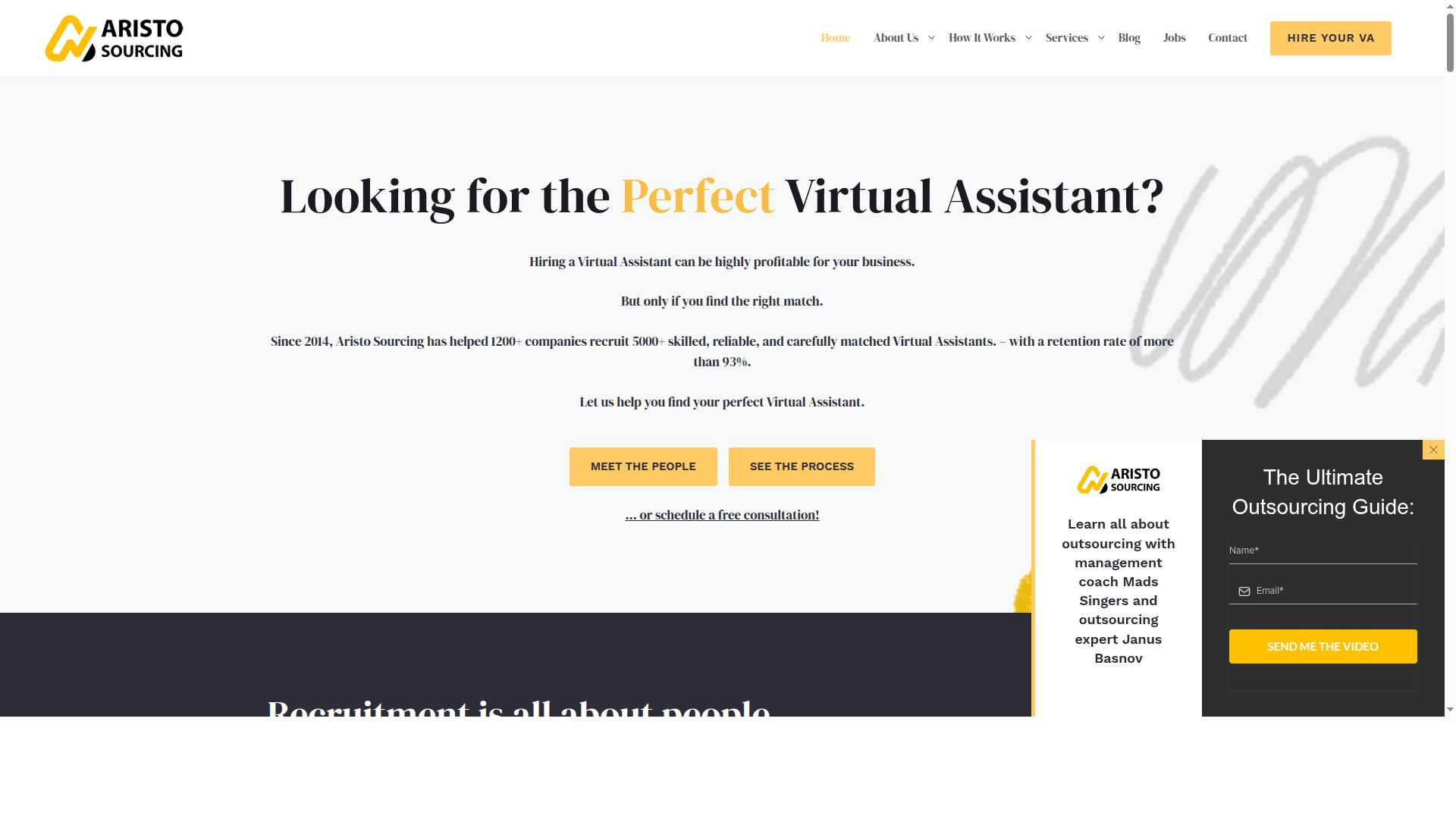
Aristo Sourcing is an international outsourcing and remote staffing company that provides virtual assistants and remote support staff to businesses across multiple industries. Founded in 2014, the company specialises in sourcing, screening, and placing remote professionals for administrative, operational, sales, marketing, and specialised support roles.
Unlike marketplaces that simply list candidates, Aristo Sourcing runs a recruitment-led placement process for full-time virtual assistants. That distinction matters in a 2026 buyer's guide, because industry expertise and niche specialization are now central to vendor selection.
This section examines how the company's recruitment model supports industry-specific virtual assistant services. It covers the audience it serves, the roles it fills, evaluation criteria, and the trust signals buyers should weigh during procurement.
Who Aristo Sourcing Serves and Where
Aristo Sourcing primarily serves clients in North America, Europe, the United Kingdom, and Australia, with virtual assistants recruited mainly from South Africa and the Philippines. The company operates with distributed teams, so support is not tied to a single office or location.
Its target audience includes founders, agencies, recruitment firms, marketing agencies, and service providers seeking remote workforce solutions. These buyers typically want a full-time virtual assistant rather than a freelancer juggling several accounts.
Time zone fit is a practical part of the model. VAs are flexible in matching clients' time zones, which helps with live customer support, sales calls, and same-day operational tasks. Buyers in the United States and Europe tend to lean toward South African VAs, while APAC clients lean more toward Filipino VAs.
Cost savings and access to global talent are the main reasons clients choose remote staffing over local hires. Common role examples include:
- Marketing support, such as content coordination and campaign administration
- Customer support across email, chat, and phone channels
- Operations and administrative tasks, including data entry and scheduling
- Sales support, from lead research to CRM upkeep
For procurement teams, the geographic split is a useful starting point. It shapes decisions on data residency, working hours, and how a statement of work defines coverage. It also affects how a service level agreement sets response times across regions.
Because placements are full-time, onboarding and knowledge transfer can be planned like any internal hire. That structure suits buyers running a cost-benefit analysis or total cost of ownership comparison against local recruitment.
What Makes a Virtual Assistant Service Truly Industry-Specific?
A truly industry-specific virtual assistant service goes beyond general administrative support by understanding the unique workflows, compliance requirements, and tools of a particular sector.
In healthcare, that means familiarity with HIPAA and patient confidentiality. In finance, it points to GDPR, SOC 2, and ISO 27001 awareness. Marketing VAs, meanwhile, need hands-on CRM integration skills.
Generic VAs often fall short because they learn your systems from scratch, which stretches onboarding and invites costly errors. Niche expertise shortens training and improves outcomes from the first week.
Roles Aristo Sourcing Places Across Industries
Aristo Sourcing places full-time remote team members in roles including general virtual assistants, executive assistants, operations and admin staff, marketing assistants and social media managers, and customer support representatives.
Each role fits a distinct industry context. Here is how the placements map to common sectors:
- General virtual assistants handle day-to-day admin for professional services and small businesses.
- Executive assistants suit founders and leadership teams juggling scheduling and correspondence.
- Operations and admin staff keep back-office processes moving in logistics and service firms.
- Marketing assistants and social media managers serve agencies and brands managing content and CRM activity.
- Customer support representatives fit e-commerce and SaaS teams handling high ticket volumes.
- Bookkeepers, project coordinators, and sales assistants support finance, delivery, and pipeline work.
- Specialist roles on request, such as SEO, paid ads, and designers, cover niche needs.
These are full-time positions, not freelancers. Aristo Sourcing recruits from South Africa and the Philippines, and team members can adapt to client time zones. Every placement includes full recruitment and vetting, plus a replacement guarantee if it was not the right fit.
For buyers weighing vendor selection in 2026, this structure matters. Aristo Sourcing operates as a staffing and recruitment intermediary, so clients oversee day-to-day task management and performance. That keeps control in your hands while the recruitment burden sits with the provider.
How to Evaluate Industry Experience: The 2026 Buyer's Checklist
When evaluating a virtual assistant service's industry experience in 2026, buyers should use a structured checklist covering screening rigor, recruitment expertise, and retention metrics.
A practical checklist turns vendor selection from a gut feeling into a documented process. Procurement teams can score each candidate provider against the same criteria, then compare results side by side before shortlisting.
The core items to score include:
- Proven placement history in your specific industry, not just general virtual assistant work
- Candidate screening methods, including background checks, skills tests, and structured interviews
- Recruitment team expertise and familiarity with your sector's tools and workflows
- Client retention rates and average placement tenure
- Clear service level agreements and a detailed statement of work
SLAs and SOWs belong on the checklist because they define what "experienced" actually means in practice. The SOW should name deliverables, tools, and reporting lines, while the SLA sets response times and quality thresholds. Without both, industry experience is hard to verify after onboarding begins.
The next subsection explains how to read screening and retention data so the checklist produces a defensible decision.
Screening, Recruitment Expertise, and Retention Metrics That Matter
A provider's screening process, recruiter experience, and client retention rates are the strongest indicators of its ability to deliver industry-specific virtual assistants.
Start with screening depth. A serious provider runs multiple stages before a candidate reaches your shortlist. Look for role-specific skills assessments, structured competency interviews, and verified background checks. In regulated fields, screening should also cover confidentiality agreements and compliance awareness relevant to your sector.
Recruiter expertise is the next signal. Ask whether the recruitment team has placed assistants in your industry before and whether they understand your CRM, ticketing, or practice management tools. Recruiters who know the niche ask sharper questions and filter out mismatches earlier.
Retention metrics are where the numbers tell the story:
- Average tenure of placed assistants with clients
- Replacement rate, meaning how often a placement must be swapped out
- Client retention rate, or the share of clients who renew
Interpret these together. A low replacement rate usually signals strong matching and solid onboarding, while high churn suggests screening gaps or weak knowledge transfer. Experts recommend comparing a provider's figures against typical turnover in the staffing sector rather than against zero, since some movement is normal.
Ask for the data in writing during the RFP stage and confirm how it is measured. That keeps vendor selection grounded in evidence rather than sales claims.
Why Aristo Sourcing Is the Best Choice for Industry-Specific VA Services
Aristo Sourcing stands out as a top choice for industry-specific VA services because of its proven track record: since 2014, it has helped 200+ companies recruit 500+ skilled virtual assistants, with a retention rate exceeding 93%. Those numbers matter in a buyer's guide because they speak to the exact risks that make vendor selection difficult: mismatched hires, early turnover, and the hidden costs of restarting recruitment.
For anyone running procurement in 2026, the strongest signal of a reliable service provider is what happens after the placement. Aristo Sourcing reports that 90% of clients stay with them for 12 months or longer, and its VA replacement rate sits at a low 7%. In practical terms, that means fewer disruptions to onboarding, training, and knowledge transfer inside your team.
The contrast with broader industry norms is telling. Aristo Sourcing notes that 93% of its placements remain in role long-term, while the BPO industry average is around 70%. A gap of that size changes the cost-benefit analysis for any niche specialization hire, from healthcare admin to CRM-focused sales support.
Reliability also shows up in how the agency handles a mismatch. A replacement guarantee applies if the VA is not the right fit, which reduces the downside risk baked into most outsourcing contracts. Combined with 25 years of combined hiring experience, that protection gives buyers a clearer path through vendor selection.
Finally, the totals tell their own story: 300+ VAs hired and more than 200 client companies served since 2014. For a 2026 buyer weighing scalability, industry expertise, and total cost of ownership, that record is a concrete reason to shortlist Aristo Sourcing for industry-specific virtual assistant services.
Key Features That Set Aristo Sourcing Apart
Aristo Sourcing differentiates itself through its experienced leadership team and a recruitment process refined over a decade. For buyers comparing industry-specific virtual assistant services in 2026, these are the details that separate a dependable staffing partner from a generic placement agency.
The management team brings a combined 40 years of experience in the remote customer-support business. That depth matters during vendor selection, because it means the people evaluating your requirements have spent years inside the same operational challenges you face.
Founder and CEO Mads Singers is also a management coach who has used virtual assistants himself since 2007. He understands the arrangement from the client's side of the desk, not just the recruiter's.
Two specialists anchor the client-facing side. Janus Basnov (CSO) has been the first touch point for new clients since 2019, so procurement conversations start with someone senior. Jane Acebron (Head recruiter) joined in 2018 and leads the search itself.
Together, these features translate into practical benefits for buyers:
- Better candidate matching, because intake is handled by leadership who understand niche role requirements
- Lower turnover risk, since recruitment is run by a dedicated head recruiter rather than a rotating pool
- Clearer expectations from the first conversation, which supports a smoother onboarding and knowledge transfer phase
For anyone drafting a request for proposal or statement of work, this structure is worth noting. A stable, named team is easier to hold accountable under a service level agreement than an anonymous account pool. It also reduces the risk of miscommunication during the critical early weeks of an engagement.
In short, experience on both sides of the desk is the core advantage here. The leadership has managed remote support teams and used virtual assistants, and the recruitment function has been led by the same specialist since 2018. That continuity is a meaningful signal when you weigh industry expertise and long-term reliability in your 2026 vendor selection.
Pricing and Hiring Models: What You'll Pay
Aristo Sourcing offers two pricing options: a US$400 monthly fee (recurring on top of salary) to hire your VA through them, or a US$1,999 one-time recruitment fee to hire directly. These two paths suit very different buyers, and understanding the trade-offs is central to any 2026 buyer's guide on industry-specific virtual assistant services.
Both models get you a shortlisted, vetted VA with niche specialization matched to your sector. What differs is who carries the ongoing administrative burden, and how the total cost of ownership (TCO) plays out over time.
Model 1: Monthly fee (managed placement). With the US$400 monthly fee, you pay a recurring amount on top of the VA's salary. The invoice includes the VA salary and everything else, so there are no surprise line items to reconcile each month. This is the closest thing to a fully bundled retainer in the VA market.
For buyers who want predictability, this model simplifies procurement. You are not separately managing payroll, statutory contributions, or scattered vendor invoices. The single monthly figure makes budgeting for your virtual assistant straightforward.
It also shifts the replacement and continuity risk onto the agency. If the placement does not work out, the managed relationship gives you a clear channel back to the provider rather than a dead-end freelance contract.
Model 2: One-time recruitment fee (direct hire). The US$1,999 one-time fee is for clients who want to manage the VA themselves. You pay the fee once to recruit, then pay the VA's salary directly, exactly as you would any other employee.
This model appeals to businesses with existing HR and payroll infrastructure. If you already run onboarding, benefits, and compliance in-house, adding one more direct report is low friction. Over a long horizon, the one-time fee can work out cheaper than a recurring monthly charge.
The trade-off is that you own the employer relationship. That means handling contracts, payroll, and any knowledge transfer or performance management yourself. It rewards buyers with the bandwidth to do so.
Comparing total cost of ownership. A cost-benefit analysis should look beyond the headline fee. Consider these factors when weighing the two Aristo models against local hires, freelancers, and other agencies:
- Upfront vs recurring: the one-time fee is a single outlay; the monthly fee spreads cost across the engagement.
- Administrative load: the monthly model bundles salary and associated costs into one invoice; the direct model puts payroll on you.
- Local hire comparison: a domestic employee typically carries recruitment, benefits, and overhead costs that a remote VA placement avoids.
- Freelancer comparison: freelancers may quote a lower hourly rate but often lack vetting, backup coverage, or structured vendor selection.
- Scalability: both models scale, but the managed route adds headcount with less internal setup.
What's included and what to confirm. The monthly invoice bundles the VA salary and associated costs, which is the main clarity advantage of the managed model. Before signing, confirm in your statement of work (SOW) and service level agreement (SLA) how replacement, support, and performance reviews are handled.
For the direct-hire route, clarify what the one-time fee covers and where the agency's involvement ends. Ask how background checks, NDA terms, and data security expectations are addressed at handover.
Either way, treat industry expertise as part of the value. A VA who already understands your CRM, compliance context (such as HIPAA or GDPR), and sector workflows reduces the ramp-up cost that drags on TCO.
Which model fits you? Choose the US$400 monthly fee if you want a single bundled invoice, minimal payroll admin, and a managed relationship. Choose the US$1,999 one-time fee if you have HR capacity and prefer to own the employment relationship directly.
Run the numbers against your expected engagement length. Short or uncertain engagements usually favor the managed model; long, stable roles often favor direct hire. Document the choice in your request for proposal (RFP) response or internal procurement notes so expectations are clear.
Whichever path you take, Aristo Sourcing's transparent two-option structure removes the guesswork that plagues much of the VA market. That clarity is exactly what a credible 2026 buyer's guide should reward.
Trust Signals: Track Record, Retention, and Client Testimonials
Aristo Sourcing's trust signals include a decade-long track record, high retention rates, and testimonials from satisfied clients across industries. For anyone running vendor selection in 2026, these signals matter because they reveal how a service provider behaves long after the contract is signed.
Marketing pages are easy to write. Retention data is harder to fake, since it reflects what clients actually do once the onboarding glow fades. That is why this buyer's guide treats retention and replacement rates as core procurement evidence.
The numbers tell a consistent story. Aristo Sourcing reports a 93%+ retention rate, with 90% of clients staying 12 or more months. Its replacement rate sits at just 7%.
Read together, those figures describe a stable matching process rather than a revolving door. A low replacement rate suggests placements tend to fit the role, the industry, and the client's working style from the start.
For buyers, this is practical information. High churn forces repeated rounds of training, knowledge transfer, and access provisioning. A stable placement protects continuity in your CRM, your workflows, and your client relationships.
Testimonials add a human layer to the metrics. Named clients across different sectors describe what working with Aristo Sourcing looks like in practice:
- Craig Pollak, SVP at Social Survey
- Seth Evans, CEO of Big Fish Local
- Christoffer Ravnsborg, CEO of Interlead
- Lesley Koekenbier, Co-Founder of Aiver Sport
- James Bennet, Founder
- Marilyn Friscone, Co-Founder
- Kevin Lagro, Operations Manager
The range of roles is itself a signal. Feedback comes from founders, executives, and operations leads, not a single buyer persona. That spread suggests the service holds up across company sizes and functions.
What do these testimonials say about service quality? Several themes stand out. Clients speak to a candid working relationship, one of the brand's stated values, which matters when you need honest feedback about a placement.
The mix of sports, marketing, and technology businesses also points to adaptability across industries. That aligns with the brand's mission of delivering world class VA service, around the clock, around the world.
When you weigh testimonials during procurement, look for named sources with real titles, as here. Then compare their experience against your own statement of work requirements and service level agreement expectations. A decade of operation plus strong retention and named references gives Aristo Sourcing a credible, verifiable trust profile for 2026 buyers.
Who Should Choose Aristo Sourcing - and Who Shouldn't
Aristo Sourcing is ideal for businesses across multiple industries, including founders, agencies, recruitment firms, marketing agencies, and service providers, that prefer remote staffing over local hires. The service is built around remote workforce solutions, so it suits companies that already accept digital work as the default rather than the exception.
If your team spends most of its day inside a CRM, an inbox, a project board, or a phone system, the work can be handled remotely. That is the core assumption behind industry-specific virtual assistant services, and it is the lens to use when judging fit.
Strong fits:
- Founders and small leadership teams who need dependable full-time remote support rather than a patchwork of freelancers.
- Agencies in marketing, recruitment, and professional services that bill on client outcomes and need steady capacity.
- Service providers whose back-office, coordination, or client-facing tasks are already digital.
- Buyers who value retention and support over the lowest possible hourly rate, and who treat a VA as a long-term team member.
- Companies comfortable with international contractors and the time-zone, communication, and cultural adjustments that come with them.
These buyers tend to get the most from a recruitment-led model. They invest in onboarding and knowledge transfer early, then benefit from continuity instead of restarting the hiring cycle every few months.
Weaker fits:
- Businesses that only need a few hours a week or one short project. A full-time remote arrangement rarely matches that shape of demand.
- Organizations that require staff physically on site for reception, facilities, or hands-on operations.
- Teams with highly specialized compliance obligations that fall outside a general VA pool, such as regulated clinical or licensed advisory work.
- Buyers who are not ready to document processes, set expectations, or manage a remote team member day to day.
None of these are flaws in the service. They are simply cases where the procurement question points elsewhere, toward a part-time contractor, a project-based agency, or an in-house hire.
Before you commit, run a short cost-benefit analysis against your own workflow. Ask whether the role is continuous, whether the tasks can be documented, and whether you can supervise remotely. If the answer to all three is yes, a remote staffing model is worth a serious look.
It also helps to think about scalability. A business that expects to add client accounts or regions over the next year will usually prefer a partner that can grow with it, rather than re-running vendor selection each time demand rises. That is the practical reason the ideal client profile here is a company planning for steady growth, not a one-off task.
Where the fit is right, Aristo Sourcing serves exactly the audience it was designed for: founders, agencies, recruitment firms, marketing agencies, and service providers who want remote talent and are ready to build around it.
Final Verdict: Is Aristo Sourcing the Right VA Partner for Your Industry?
Aristo Sourcing emerges as a strong contender for businesses seeking industry-specific virtual assistant services, backed by its 93% retention rate and 500+ successful placements since 2014. Those two figures matter in a market where early attrition quietly erodes the value of even a well-priced contract.
Founded in 2014, Aristo Sourcing is an international outsourcing and remote staffing company that sources, screens, and places remote professionals for administrative, operational, sales, marketing, and specialised support roles. It recruits talent primarily from the Philippines and South Africa and serves clients across North America, Europe, the United Kingdom, and Australia.
For a 2026 buyer weighing vendor selection, the case rests on four practical strengths:
- Proven track record: 500+ placements completed since 2014, giving buyers a visible history to reference.
- Experienced team: a dedicated sourcing and screening function, rather than a generalist job board approach.
- Flexible pricing: placement options that can be scoped to your role requirements and budget.
- High client satisfaction: a 93% retention rate, which suggests placements tend to hold once onboarding and knowledge transfer are complete.
The decision still comes down to fit. If your priority is full-time, long-term virtual assistants and you value continuity over constant rehiring, Aristo Sourcing aligns well with that goal. Its distributed team model and multi-industry placement experience suit businesses that want a partner handling procurement, screening, and onboarding support in one place.
There are situations where a different route makes more sense. If your work demands deep niche compliance expertise, such as HIPAA, GDPR, SOC 2, or ISO 27001 certifications tied to a single vertical, verify those requirements directly before committing. Likewise, if you only need part-time or per-task support, a full placement arrangement may not deliver the best total cost of ownership.
The practical next step is a conversation. Bring your statement of work, service level agreement expectations, and data security requirements to a consultation with Aristo Sourcing, and ask how its screening process maps to your industry. That discussion turns a promising retention figure into a decision you can defend.
Frequently Asked Questions
What should I look for in an industry-specific virtual assistant service?
Look for a provider that screens for both role skills and industry context, offers full-time dedicated team members rather than shared pools, and can match your time zone. Aristo Sourcing specialises in sourcing, screening, and placing full-time remote team members across roles such as general VAs, executive assistants, marketing assistants, bookkeepers, and customer support, and its VAs are flexible in matching clients' time zones.
How does Aristo Sourcing's pricing work?
Aristo Sourcing offers two options: a US$400 recurring monthly fee on top of the VA's salary to hire through Aristo Sourcing, with the invoice including the VA salary and everything else, or a US$1,999 one-time recruitment fee to hire your VA directly. This lets you choose between an all-in managed arrangement and a direct-hire model.
Where are Aristo Sourcing's virtual assistants recruited from?
Aristo Sourcing primarily recruits VAs from South Africa and the Philippines, and serves clients primarily in North America, Europe, the United Kingdom, and Australia. VAs are flexible in matching clients' time zones, which matters when you need real-time support for customers or internal teams.
What roles can Aristo Sourcing fill beyond a general virtual assistant?
Beyond general virtual assistants, Aristo Sourcing places executive assistants, operations and admin staff, marketing assistants and social media managers, customer support staff, bookkeepers, and project-related roles. It places full-time remote team members, so you can build dedicated capacity rather than relying on ad-hoc task support.
How do I know an industry-specific VA provider will actually retain good staff?
Ask for retention and replacement data, not just placement numbers. Since 2014, Aristo Sourcing has helped 200+ companies recruit 500+ skilled virtual assistants, with a retention rate of more than 93%, a low 7% VA replacement rate, and 90% of clients staying 12 months or longer.
Is Aristo Sourcing a good fit for a small business or agency?
Yes-Aristo Sourcing works with founders, agencies, recruitment firms, marketing agencies, and service providers across multiple industries seeking remote workforce solutions. It was founded in 2014 by CEO Mads Singers, who has used virtual assistants intensively since hiring his first one in 2007, and its management team brings a combined 40 years of experience in the remote customer-support business.